You’re a marketer who uses AI tools, perhaps for automating email campaigns, generating social media posts, or analyzing customer data. You know that AI makes life easier and campaigns smarter. But have you ever let AI marketing agents take the wheel completely?
Imagine an AI marketing agent that autonomously spots a sudden surge in customer interest during a campaign, instantly reallocates ad budgets across platforms, dynamically personalizes emails in real time, and fine-tunes product recommendations—all without you lifting a finger.
This is the leap beyond static automation and basic AI tools that AI agents promise. With agentic AI, marketers can expect autonomous, intelligent copilots that think, act, and evolve like your best strategist but at machine speed and scale.
In fact, 79% of senior executives say their companies have adopted AI agents to some extent, with 66% reporting measurable productivity gains from AI agent usage, emphasizing the growing trust and proven value of this technology in business
This blog explores what AI marketing agents really are in 2025, how they operate behind the scenes, and the specific use cases transforming marketing teams and revenues across industries.
What Are AI Marketing Agents?
AI marketing agents are autonomous software systems powered by machine learning and natural language processing. Unlike traditional marketing automation that follows preset rules, AI marketing agents continuously learn from real-time data to make independent strategic decisions.
The Key Difference:
- Traditional automation: "If X happens, then do Y"
- AI agents: "Analyze all available data, predict outcomes, and take the optimal action"
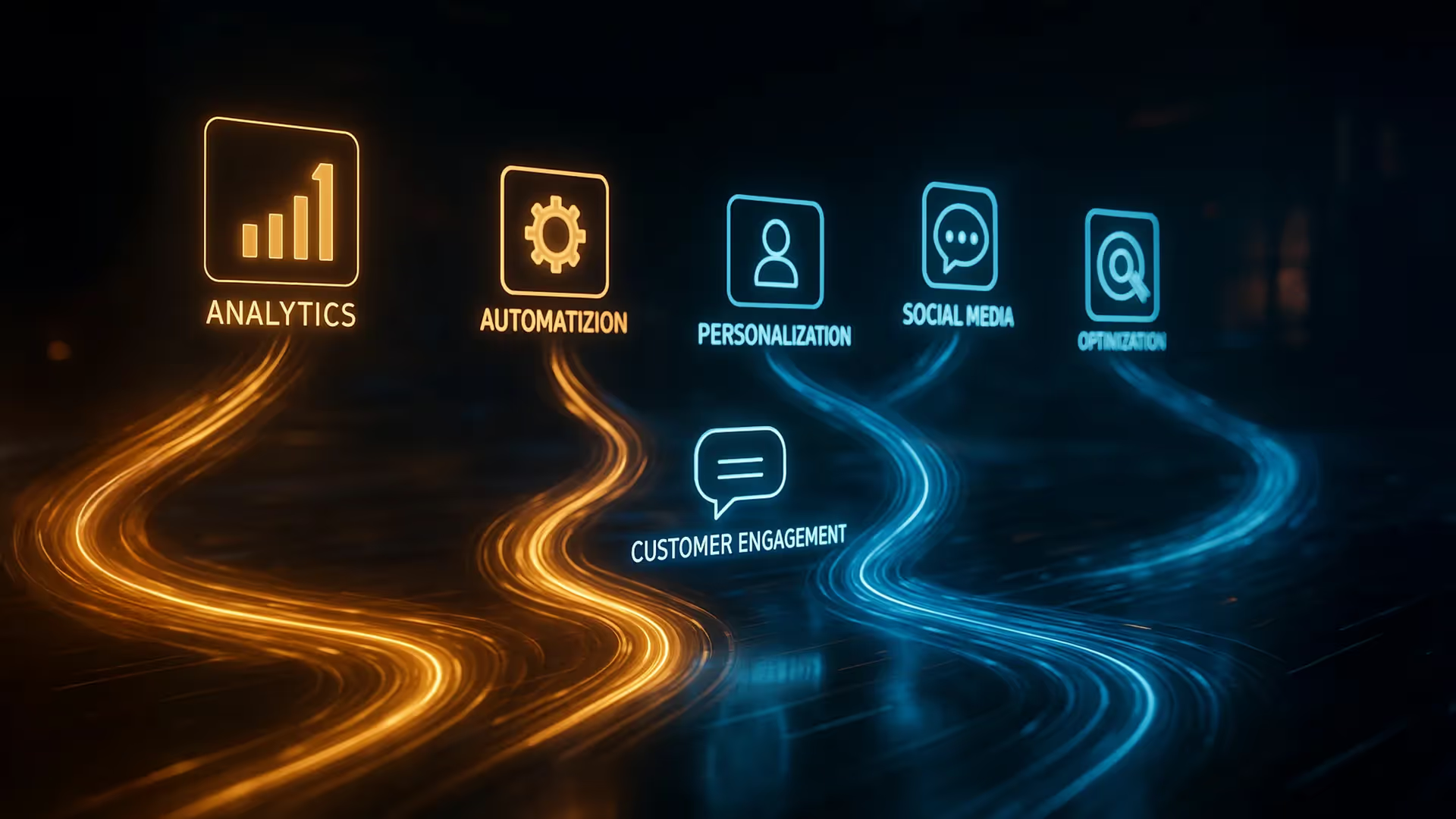
AI agents ingest massive amounts of real-time data like customer behavior, campaign metrics, social signals, and competitor activity. They can then use this data to help teams execute multi-channel strategies while providing optimization suggestions based on results.
Use Cases of AI Marketing Agents:
1. Autonomous Campaign Management and Optimization
The Challenge: Manual campaign optimization consumes 10-15 hours weekly per marketer, yet still misses 60% of optimization opportunities due to data complexity and timing delays.
How Your Team Could Approach This: You could set up AI agents to connect directly to your advertising platforms (Google Ads, Facebook, etc.) via APIs, allowing them to monitor performance data continuously. These agents would learn your campaign patterns and automatically:
- Reallocate budgets to high-performing ads within minutes
- Pause underperforming creative variants
- Adjust bids based on conversion probability patterns
- Test new audience segments based on lookalike modeling
Real-World Evidence: FARFETCH implemented AI-driven email marketing management and saw a 38% increase in click rates and 31% increase in open rates, demonstrating how autonomous optimization can significantly improve performance metrics.
2. Hyper-Personalized Customer Engagement
The Challenge: 59% of enterprise marketers are already using AI marketing agents to deliver personalization at scale, because B2B marketing has always suffered from generic messaging and dry content, leading to missed conversion opportunities.
How Your Team Could Approach This: Your marketing team could implement AI marketing agents that create unified customer profiles by aggregating data from your existing systems—CRM, website analytics, email platforms, and social media. The agents would then:
- Generate personalized email content based on individual behavior patterns
- Optimize send times for each customer's engagement windows
- Dynamically adjust product recommendations in real-time
- Customize landing page experiences based on traffic source and history
Real-World Evidence: Netflix's AI-driven recommendation system drives over 80% of content consumption, while Starbucks' Deep Brew AI system increased average transaction values through personalized recommendations.
3. Smart Lead Scoring and Routing
The Challenge: Sales teams spend 50% of their time on unqualified leads, while 27% of high-value prospects get misrouted or delayed.
How Your Team Could Approach This: Your sales and marketing teams could collaborate to implement AI agents that analyze multi-channel signals from your existing tools. The system would learn from your historical conversion data to:
- Score leads based on behavior patterns, demographics, and engagement signals
- Route high-value prospects to your most experienced sales reps
- Automatically nurture mid-tier prospects with targeted content sequences
- Flag accounts showing buying intent spikes for immediate attention
Real-World Evidence: Companies implementing AI lead scoring typically see 50% more qualified leads and 37% faster sales cycles, according to industry studies.
4. Data-Driven Content Strategy and Generation
The Challenge: Content teams struggle to maintain consistent quality while meeting demand—84% of marketers report speed challenges in delivering high-quality content.
How Your Team Could Approach This: Your content team could make use of agentic AI marketing tools that integrate multiple data sources to inform strategy before creating content. This approach involves:
- Analyzing keyword data and People Also Ask (PAA) queries to identify content gaps
- Conducting competitor research to understand market positioning and content opportunities
- Using market intelligence to inform product descriptions and e-commerce listings
- Generating SEO-focused content that ranks while maintaining brand voice consistency
For example, platforms like Yarnit demonstrate this approach by combining keyword analysis, competitor intelligence, and market research data to help brands create strategic content. The system analyzes search trends, identifies content opportunities, and generates SEO-optimized materials that align with both search intent and brand messaging.
5. Multi-Agent Ecosystem for Omnichannel Coordination
The Challenge: Marketing channels operate in silos, creating inconsistent messaging and missed cross-channel optimization opportunities.
How Your Team Could Approach This: Rather than building individual AI tools from scratch, your marketing team could implement a coordinated multi-agent system where specialized AI marketing agents—each trained for specific marketing roles—work together under unified strategy. This ecosystem would include:
- Social media copywriters that understand platform-specific best practices
- Blog writers trained on SEO requirements and brand voice
- Research agents that analyze market trends and competitor activities
- Design experts that maintain visual brand consistency across channels
- SEO specialists that ensure content optimization across all materials
Ask Yarnit is a clear example of this multi-agent approach, bringing together a complete AI marketing team in one platform. Each agent is fine-tuned for specific marketing functions—from social media strategy to technical SEO—while sharing insights to maintain consistency. For instance, when the research agent identifies a trending topic, the blog writer and social media agents coordinate to create complementary content that reinforces the same message across channels.
Measuring the Impact and ROI of AI Marketing Agents
The numbers discussed in the blog tell the story. But beyond the metrics, AI marketing agents free your team from routine optimization tasks, enabling focus on strategy, creativity, and authentic customer relationship building.
For companies in 2025, the question isn't whether to adopt AI agents—it's how quickly you can implement them to stay competitive. Ready to transform your marketing operations? The future of marketing is autonomous, and Yarnit is leading the way. With our generative AI platform, Yarnit helps businesses maximize the effectiveness of their marketing campaigns through high-quality, contextual content creation.
It’s time you make AI agents your digital marketing partners and watch your campaigns and relationships flourish like never before. With Ask Yarnit, you can experience the future of marketing with your very own AI marketing team. Try Yarnit today or reach out to know more.