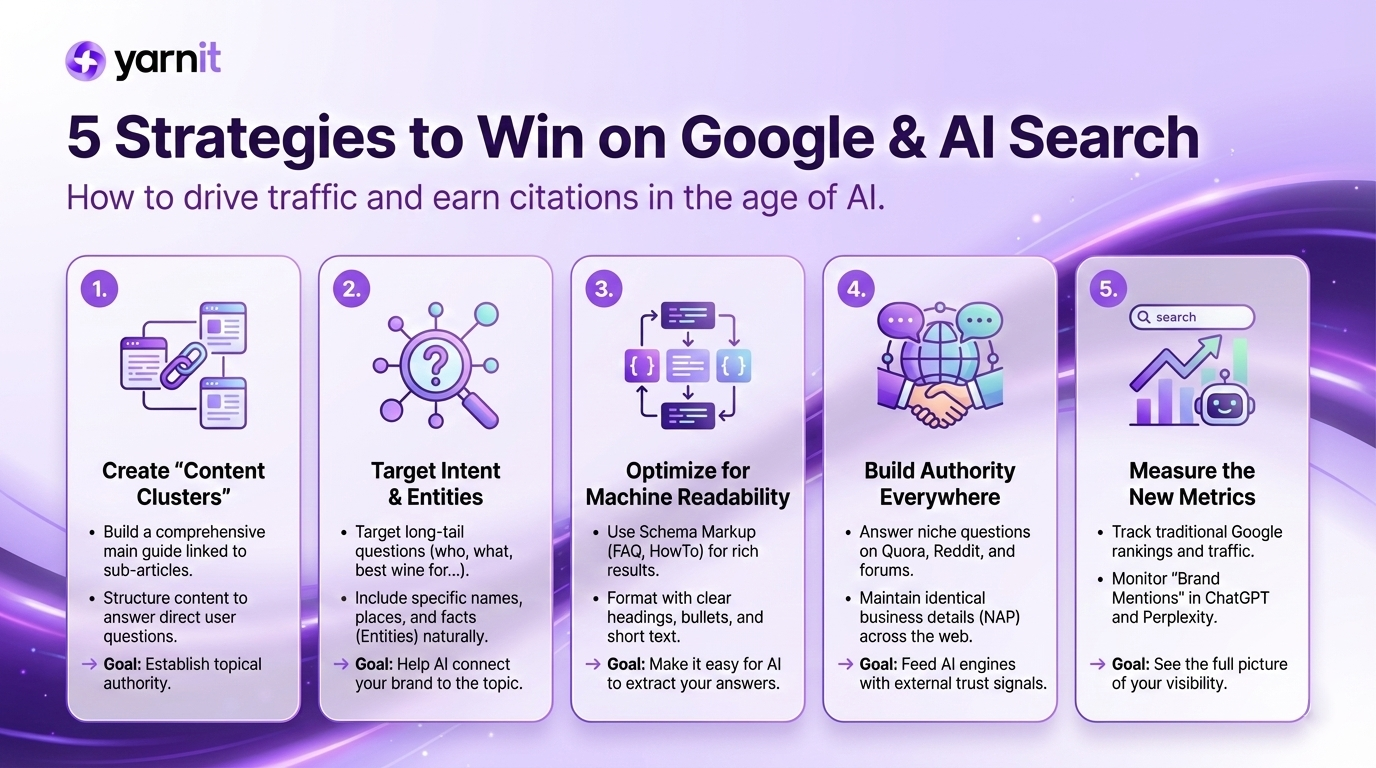
Integrating traditional SEO with Generative Engine Optimization (GEO) is essential to ensure your brand stays visible across both search engines and AI-powered answer platforms like ChatGPT and Google’s AI Overviews.
Users are finding answers before they ever visit your website—but are you overlooking AI platforms, even though that’s where your audience is. With the rapid rise of generative AI tools like ChatGPT, Perplexity, and Google’s AI Overviews, the way people search for information is changing fast. More users are turning to these AI-powered platforms for instant answers, rather than scrolling through traditional blue links.
According to AIOSEO, over half of the sources cited in Google’s AI Overviews already rank in the top 10 organic results. But AI is also bringing new content and brands into the spotlight—ones that might never have reached page one through traditional SEO. As zero-click searches and AI-generated answers become the norm, relying solely on conventional SEO is no longer enough.
If your brand isn’t optimizing for both traditional SEO and Generative Engine Optimization (GEO), you’re missing out on a massive share of visibility and engagement. The future of search requires mastering both. Let's explore why geo vs seo matters and how to win in both spaces.
Understanding Geo vs SEO
When discussing geo vs seo, it's important to understand what each discipline actually does.
SEO (Search Engine Optimization) is the established practice of improving your website’s visibility in search engines by optimizing on-page elements, building backlinks, and ensuring technical health. The goal: attract organic traffic by ranking higher for relevant queries.
GEO (Generative Engine Optimization) is the emerging discipline of making your content discoverable, understandable, and referenceable by AI-powered engines. These engines— Google’s AI Overviews, ChatGPT, and Bing Copilot—don’t just crawl and index; they summarize, synthesize, and cite. GEO focuses on entity clarity, semantic structure, and context, so your brand is referenced in AI-generated answers and conversational search results.
Why integrate them? The lines between traditional search and AI-driven discovery are blurring. Relying on SEO alone risks missing out on AI citations. GEO without SEO lacks the foundational authority and trust that search engines value. Integration ensures your brand is present wherever users search or ask questions—whether it’s a Google search, a voice assistant, or an AI chat.
The Impact of GEO on Modern Search Results
Generative AI is fundamentally changing how information is retrieved and presented. Platforms like Google’s AI Overviews and ChatGPT now deliver direct answers, summaries, and recommendations—often without users clicking through to websites. According to Search Engine Land, over 400 million people use AI chatbots and generative search tools every week.
What does this mean for brands?
Content must be structured so AI can easily extract and reference it.
Being cited by AI engines can drive brand awareness, even when users don’t click.
Authority, clarity, and context are more important than ever for being chosen as a source.
How to Integrate SEO with GEO: Actionable Strategies
1. Build a Unified Content Strategy
Why this matters:
The biggest mistake in the geo vs seo debate is treating them as separate content problems. Marketers create content for traditional search engines separately from content designed for AI-driven answer engines. This compartmentalization wastes resources and limits reach.
AI engines like ChatGPT, Google’s AI Overviews, and Perplexity are not just indexing your site; they’re synthesizing information and serving direct answers. If your content isn’t structured for both, you’ll miss out on organic rankings and AI citations. Want to rank high on Chatgpt, read our comprehensive blog on five strategies to rank on ChatGPT.
How to do it:
Topic Clusters: Organize your content around core themes (e.g., “Wine Tasting for Beginners”) and build out related subtopics (e.g., “How to Taste Wine,” “Common Wine Tasting Mistakes,” “Wine Tasting Etiquette”). Interlink these pieces to establish topical authority.
Conversational Content: Write in a way that answers direct questions. Use FAQs, how-to guides, and clear definitions. This not only boosts your chances of ranking for featured snippets but also increases the likelihood of being cited by AI engines.
Content Depth: Don’t just skim the surface. Comprehensive, in-depth content is more likely to be referenced by both Google and AI engines.
Example: A travel brand creates a “Complete Guide to Paris” with linked articles on neighborhoods, local cuisine, safety tips, and travel itineraries. The main guide answers broad questions, while subpages address specific user intents.
2. Expand Keyword Research to Include Prompts and Entities
Why this matters:
SEO has always relied on keyword research, but GEO requires you to go deeper. AI engines don’t just match keywords—they interpret the intent behind queries and look for relevant entities (people, places, products, events) to provide richer, more accurate answers. If you only target generic keywords, you’ll be invisible in conversational and entity-driven AI results.
How to do it:
Long-Tail & Conversational Queries: Use tools like SEMrush, AnswerThePublic, and Google’s “People Also Ask” to find the actual questions users are asking. Optimize your content to answer these directly.
Entity Mapping: Identify all relevant entities for your topic. For a wine retailer, this might include grape varieties, wine regions, tasting notes, and food pairings. Mention these entities naturally and frequently in your content.
Prompt Analysis: Think about how users phrase questions to AI engines versus traditional search. Many queries appear in both forms. Incorporate those prompts: "What's the best wine for beginners?"- as subheadings or in your FAQs to address both geo vs seo audiences.
Example: Instead of just optimizing for “best Italian wine,” a wine merchant also targets “Which Italian wine is best for pizza?” and “What are the most popular Italian red wines in 2025?”—covering both SEO and AI prompt territory.
3. Optimize for Retrievability
Why this matters:
Both search engines and AI answer engines need to quickly understand and extract information from your content. If your site is a wall of text or lacks structured data, you’re making it difficult for algorithms to surface your answers—reducing your visibility in both classic search and AI summaries.
How to do it:
Schema Markup: Implement FAQ, HowTo, Product, and LocalBusiness schema where relevant. This helps machines understand your content’s context and purpose.
Clear Formatting: Use headings, bullet points, and short paragraphs. Start answers directly under each question.
Direct Answers: Summarize key points at the top or in dedicated “Key Takeaways” boxes.
Example: A legal services firm uses FAQ schema to answer “How long does a divorce take in California?” and “What are the steps for filing?”—making it easy for Google and AI engines to extract and display these answers.
4. Distribute Content Across Multiple Channels
Why this matters:
AI engines draw from many sources beyond your website. If your brand is active and authoritative on forums, review sites, and social platforms, you're much more likely to be cited in AI-generated answers. Understanding geo vs seo means recognizing that authority built through multiple channels strengthens both your traditional rankings and AI visibility.
How to do it:
Participate in Q&A Platforms: Answer questions on Quora, Reddit, and industry-specific forums. Reference your own content where appropriate.
Encourage Reviews and User-Generated Content: Ask customers to leave reviews on Google, Yelp, or niche review platforms. Respond to comments and questions to demonstrate expertise and engagement.
Share on Social Media: Repurpose your blog content into LinkedIn posts, Twitter threads, or Instagram carousels, expanding your reach and authority signals.
Example: After publishing a “Beginner’s Guide to Wine Tasting,” a wine shop answers related questions on Quora, shares tasting tips on Instagram, and encourages customers to post their own tasting experiences—building a web of content that AI engines can reference.
5. Build Brand Authority and Consistency
Why this matters:
Both Google and AI answer engines favor brands with strong, consistent presence across the web. The geo vs seo equation requires that you win on trust first. Inconsistent information or a lack of third-party mentions undermines credibility across all channels.
How to do it:
Consistent NAP: Ensure your Name, Address, and Phone number are identical across your website, Google Business Profile, social channels, and directories.
Digital PR and Guest Posting: Pitch stories or guest articles to respected industry publications. Each mention or backlink reinforces your authority.
Influencer and Expert Collaborations: Partner with influencers or thought leaders to co-create content, boosting your authority and reach.
6. Prioritize Technical Excellence
Why this matters:If your website is slow, not mobile-friendly, or riddled with technical errors, it won’t rank well in Google—and AI engines may not even be able to crawl or understand your content. Technical SEO is the foundation for both visibility and retrievability.
7. Track Performance Across Both Search and AI Platforms
Why this matters: If you’re only tracking traditional SEO metrics (rankings, traffic), you’re missing the new frontier: AI-generated citations and mentions. Understanding where and how your content is referenced in AI answers gives you a fuller picture of your digital visibility.
How to do it:
Traditional Analytics: Use Google Analytics and Search Console to track organic performance.
AI Monitoring: Set up Google Alerts, Brand24, or Mention to track citations, and monitor platforms like Perplexity or ChatGPT for references to your brand.
Review & Adapt: Regularly review what types of content are getting surfaced by AI engines and double down on those formats.
Mastering Geo vs SEO for 2026 and Beyond
To stay visible and competitive in 2026, integrating GEO and SEO is essential:
Build unified, entity-rich content clusters.
Combine traditional keyword research with semantic and conversational optimization.
Invest in technical excellence and structured data.
Track both organic and AI-driven performance, and adapt continuously.
Start with a thorough audit of your current strategies and identify gaps where you're underperforming in either traditional search or AI visibility. Commit to ongoing learning as search technology evolves. The brands that win won't be choosing between geo vs seo—they'll be mastering both.
This is where Yarnit comes in. Yarnit’s AI-powered content strategy and SEO tools are designed to help marketers create high-ranking, search-optimized content that drives organic traffic and boosts online visibility. With Yarnit, you can:
Instantly generate SEO-qualified content ideas tailored to your brand, audience, and current search trends, ensuring your editorial calendar is always filled with relevant topics
Use the SEO agent in Ask Yarnit to perform advanced keyword research—including conversational and long-tail keywords—which is especially valuable for GEO.
Build out detailed, SEO-ready outlines and content briefs, so your team can produce comprehensive, structured content that’s optimized for both Google and AI answer engines
Continuously refine your content using Yarnit’s editor and auditor, ensuring every piece is polished, on-brand, and aligned with SEO best practices
See exactly why your Product Detail Page isn't converting
Thank you! Your submission has been received!
Oops! Something went wrong while submitting the form.
Frequently Asked Questions
What is Generative Engine Optimization (GEO) and how does it differ from traditional SEO?
GEO helps AI engines like ChatGPT find and cite your content by focusing on clear entities and context. Traditional SEO targets ranking in search results, while GEO optimizes for AI-powered answers.
Why combine SEO and GEO?
Combining both ensures your brand appears in regular search results and AI-generated answers, maximizing your reach and visibility across platforms.
How do I optimize content for AI search engines?
Use detailed topic clusters, conversational language, and apply schema markup like FAQ and HowTo to help AI understand your content.
What technical SEO supports AI visibility?
Have a fast, mobile-friendly site, use appropriate schema markup, maintain clean site structure, and fix crawl errors regularly.
How to track performance in SEO and AI?
Use Google Analytics and Search Console for SEO. Monitor AI citations with alerts and brand monitoring tools to track your AI visibility.